 SEG exhibition stands, made to order
Hanging Signs and Towers: Getting Found in the Hall
At floor level, a busy exhibition hall is opaque. People are tall, crowds are dense, and an 8ft backwall disappears from view at about forty feet. Everything above head height is permanently clear, and almost nobody uses it properly.
That is the whole argument for hanging signs and towers. They are not decoration; they are the only part of your stand that is visible from the entrance.
Hanging banners
A hanging banner is a lightweight aluminium ring or frame with a tensioned fabric print pulled over it, rigged above your stand. Printed on every face, it reads from any direction and it folds into a carry bag.
Sizing it to the stand
- Over a 10x10: 5ft to 6ft across. Larger looks disproportionate and will often breach the footprint rule, which usually requires the banner to sit within your own stand's boundary.
- Over a 10x20: 8ft to 10ft across, or a rectangular banner running the long axis.
- Over a 20x20 island: 10ft to 16ft across. This is where tiered and multi-level shapes earn their cost.
Hanging height is measured to the bottom edge, and 16ft to 20ft from the floor is typical. Below about 14ft you are inside the visual clutter of the hall; above 22ft most halls will not permit it. Check your exhibitor manual — the drape limit, the weight per rigging point and whether rigging is permitted at all are set per show, not per hall.

Shapes, and what each is good for
Round reads identically from every direction, which is why it is the default over an island. There is no bad angle and no edge-on view.
Square suits a rectangular footprint and gives four clean faces. From a corner you see two of them at once, which can carry a brand mark and a line of copy together.
Triangle gives three distinct faces, so three messages — but each is narrower. Good when you genuinely have three things to say to three audiences; wasteful when you do not.
Tapered and tiered add height without adding width, which matters when the footprint rule limits your span. A tiered circular sign is the most visible thing you can hang over a 20x20 without breaching the boundary.
Flat panel is the cheapest per square foot of print and the most directional. Fine above an inline stand where people only approach from one side; a poor choice over an island.
Print every face
A banner printed on one side is invisible to half the hall, and the saving is small — the cost difference is the print, not the hardware. If you are spending the money to rig something at all, print it all the way round.
Towers, for when rigging is not an option
Plenty of halls prohibit rigging, and most hotel ballrooms do. Some shows allow it only for island positions. In all of those cases a tower does the same job from the floor.
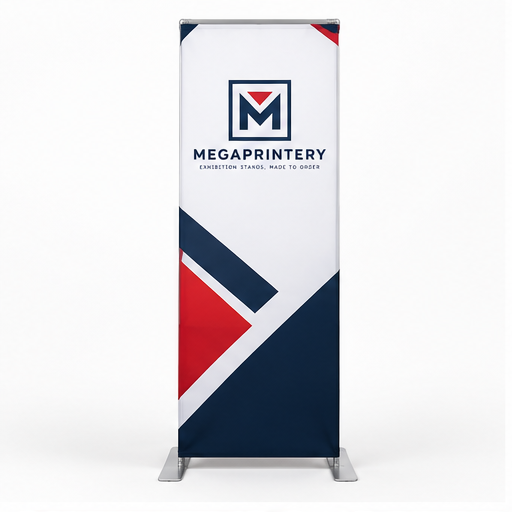
A collapsible SEG tower runs from counter height up to over 10ft, printed on all faces, breaking down into a single wheeled case and standing up without tools. It is not as high as a hanging sign, but it is considerably higher than your backwall and it needs no rigging order, no labour call and no approval.

Where to place them
On an island, at the corners — they mark the boundary of your space and they frame the approaches. On an inline stand, at the front edges, flanking the entry. Never in the middle of the floor, where they block sight lines through your own stand and get knocked.
Lit towers
A backlit tower is visible from substantially further away than a printed one, and on a tower that is the entire point. Because they are built on the same extrusion as our lightboxes, a lit tower uses the same 200g backlit fabric and the same LED profile as a lit wall, so the whole stand reads as one piece.
Designing for the viewing angle
Three things people get wrong.
Too much copy. A hanging sign is read at 60 to 100 feet. That is a brand name and possibly three words. Anything more is illegible and is wasting the one surface everyone in the hall can see.
Artwork designed flat. On a round or tapered banner the surface curves away, so the edges of your layout compress. Keep the important content in the middle 70% of each face.
Forgetting it is seen from below. Everyone looking at a hanging sign is looking up at a steep angle. Content on the lower half of each face reads better than content on the upper half.
The paperwork
Rigging is a show service billed by the hall, not by us. You order it from the general contractor, you give them the weight and the rigging points, and they hang it during move-in. Order it in advance; rigging requested on the day is expensive where it is available at all.
We fit the rigging points to the hall's requirement — tell us the show and we will fit accordingly. Weights and dimensions are published on every product page so the rigging form is filled from the specification.
What we build
Round, square, triangle, tapered and tiered hanging banner frames; collapsible display towers from counter height to over 10ft; both lit and unlit, printed on every face, on flame-retardant fabric.
Browse hanging banners and display towers, or see the sizing guide for arches and hanging banners. Shipping to mainland USA is included, lead time is 48 hours, and the hardware carries a two-year warranty.